

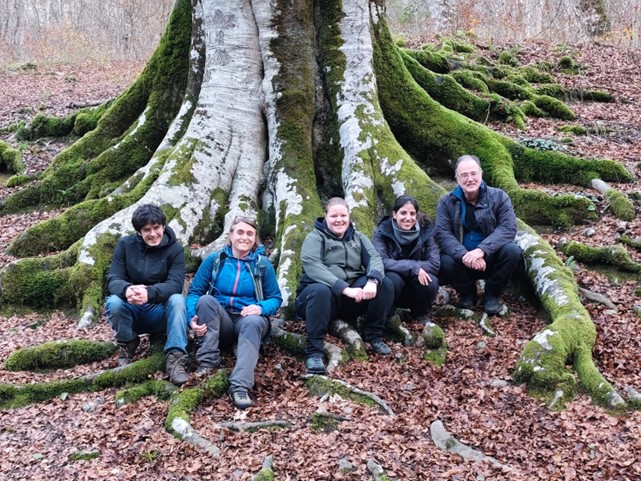
From 24 to 26 November, in the Pollino National Park (Basilicata Region), the UniFi and BlueBiloba teams met with Professor Max Bruciamacchie (Association Futaie Irrégulière, France) and several members of ProSilva Italy to advance Task 4.4: Training for reproducibility of Closer-to-Nature Silviculture in Europe.
Task 4.4 foresees the installation of ten demonstration stands to support the progressive adoption of Closer-to-Nature Silviculture (CNS) in ten EU countries, along with seven training events in seven different countries. The stands will be selected among the proposals submitted under Activity 3 of the SMURF project’s second cascade funding call with an homogeneous distribution across the EU. Each stand will host a monitoring protocol in fixed plots based on the monitoring protocol developed by AFI (the AFI device, from the French dispositif), designed to assess the functioning and long-term dynamics of irregular forest management.
In this context, one (or potentially two) of the first demo stands will be established in Southern Italy, in close collaboration with AFI and ProSilva Italy. A specific training on the installation of the monitoring protocol will be organised for the SMURF team in early 2026. This activity will also allow AFI to extend its monitoring network in Italy by including additional forest types and species not yet represented, while ProSilva Italy will strengthen its familiarity with the protocol—following the installation of the first Italian dispositif in the Western Alps (Val di Susa).
During this days, a preliminary field visit was conducted to identify suitable forest stands for this first installation. Several candidate forests were inspected and analysed by forestry experts from AFI, ProSilva Italy, UniFi and BlueBiloba.
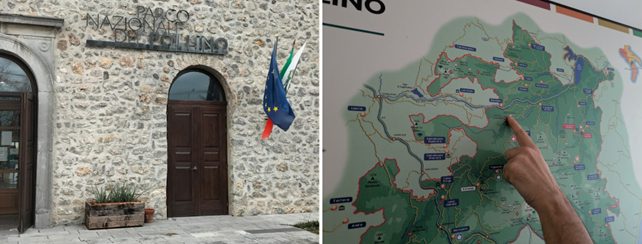
The study area—Pollino National Park—hosts pure and mixed beech forests exhibiting various degrees of structural irregularity, Turkey oak high forests, Italian oak stands and mixed broadleaved formations, alongside the emblematic endemic Heldreich’s pine.
Day one
The first day opened with a round table on the characteristics of Pollino forests and the evolution of forest management in the area. Dr. Aldo Schettino (Pollino National Park) described how Silver fir, once widespread and economically important, underwent a progressive and not yet fully understood regression, allowing beech to expand extensively. He also outlined how irregular management systems were only partially adopted in past management plans, largely influenced by the long-standing dominance of the Florentine Forestry School and its tradition of applying regular shelterwood systems.
Italian members of ProSilva recalled this historical context while discussing the gradual introduction of CNS approaches. The work of Professor Famiglietti, building on Susmel’s earlier efforts in Southern Italy, has contributed to increased attention toward irregular stand structures
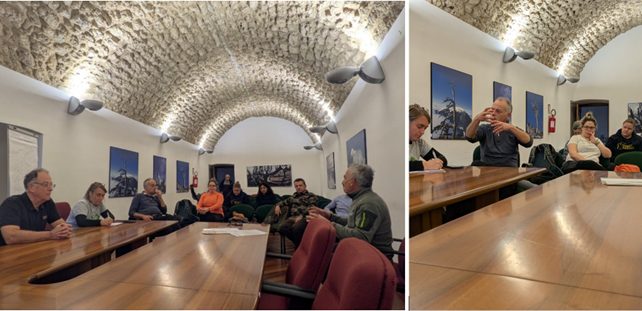
The discussion then focused on the ambition to promote active irregular management, while acknowledging the challenges posed by the need to limit harvesting in areas with high tourist visitation. An emblematic example is the recent designation of a monumental Turkey oak stand as old-growth forest, which now obstacle forestry operations in the selected plot.
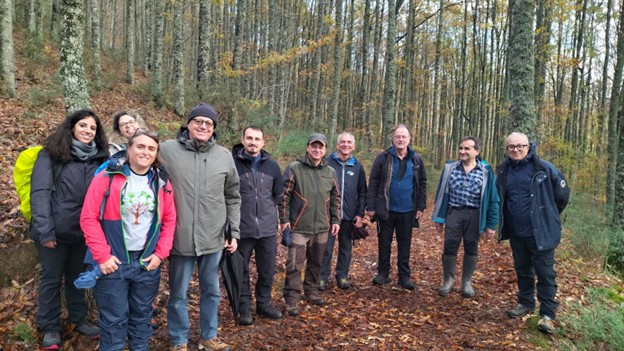
The first visit took place in “Bosco Magnano – San Severino”, a Turkey oak high forest managed by the National Park. The stand is mature (mainly 40-50 years) and derives from the conversion of coppice. It shows a moderate diameter diversification, even though it is even-aged. The site is very fertile thanks to the high soil permeability. The current management approach is the regular shelterwood system (with regeneration cuttings at 120 years), but a new management plan is about to be presented and a transition toward an irregular forest structure may begin. In the upper part of the forest, there is a significant presence of ageing trees, reaching heights of around 40 metres. The persistence of these giant trees within a former coppice system is linked to past livestock grazing activities in the forest.
Professor Bruciamacchie from AFI assessed the forest as suitable for installing the first monitoring device (the AFI “dispositif”) for the SMURF project. During the visit, he illustrated AFI’s criteria for selecting stands appropriate for inclusion in the network: a minimum area of 15 hectares; a mature but not senescent developmental stage; and trees aged 40–50 years.
The group also discussed issues related to Quercus cerris wood quality. Local technicians noted that in Basilicata the species is currently used almost exclusively for firewood due to the lack of alternative markets. Dr. Schettino highlighted known limitations of Q. cerris wood (such as its high density, as well as the tendency to warp and difficulties with adhesion), but underlined that utilisation ultimately depends on available technologies, which—if improved—could diversify potential uses.
Professor Bruciamacchie emphasised the key factors for understanding both forest dynamics and the broader socio-economic context: the annual increment and the potential wood value, which should be assessed with reference to markets where the species is more highly valued. He mentioned that in parts of Eastern Europe (e.g., Serbia) Turkey oak is processed for the production of barrels and furniture. Currently, Turkey oak from Bosco Magnano is sold for firewood for 15–18 €/m³ as standing timber and 50–60 €/m³ at the timber yard.
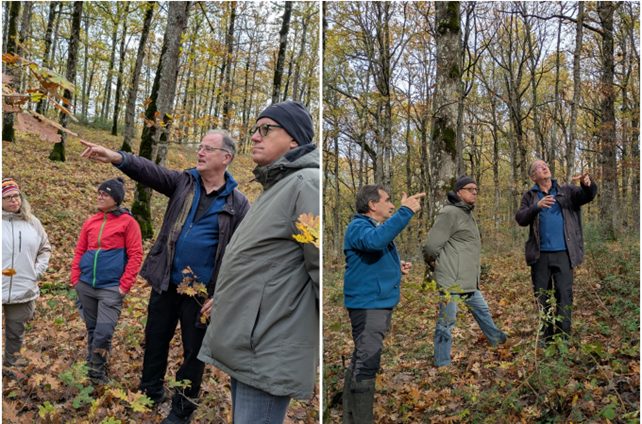
Focusing on the importance of encouraging high-quality timber within stands, Professor Bruciamacchie explained AFI’s tree-oriented selection approach, stressing that irregular stand structure is not the goal of this silviculture but rather a consequence of consistent application of selection principles.
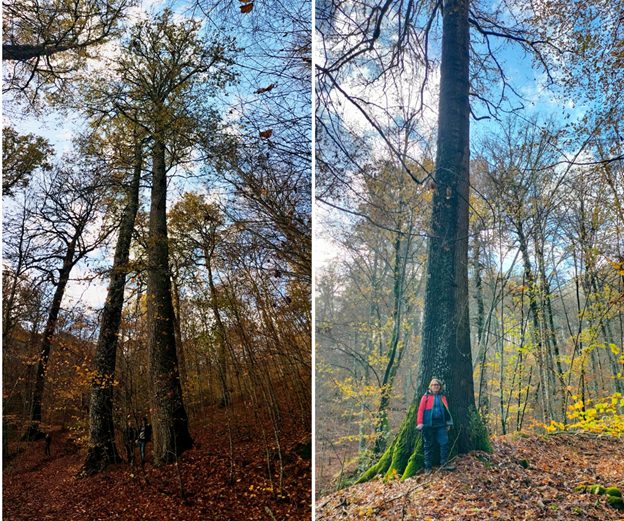
The field day concluded as the last light faded from the forest, with a final photograph taken under the canopy of a monumental beech in the lower section of the Park’s mixed deciduous forest.
Day two
During the second day, the group moved northwards to the forests of Magrizzi and Castronuovo. The visited stands present Italian oak (Quercus frainetto Ten.) as the dominant species, a marcescent oak scattered in Southern Italy and very little studied. The two sites are particularly suitable for the species, which requires fertile, mild hills and valleys. The Italian participants presented the species to Professor Bruciamacchie and discussed business opportunities related to its management. While currently its wood is sold only as firewood (and with a lower value compared to other oaks), its quality should be more similar to English oak and Sessile oak. Despite its rather limited annual growth, the species was considered more interesting for wood valorization than Turkey oak.
The first forest, under regional ownership, is an even-aged high forest where Italian oak covers about 50% of the stand, mixed with the more common Quercus cerris. The stand is around 70 years old, and the new management plan has recently proposed moving towards a continuous cover approach, whereas the previous plan assumed a regular shelterwood system. The group remained in the forest only as long as needed to discuss this change between the plans and then moved to the nearby second stand.
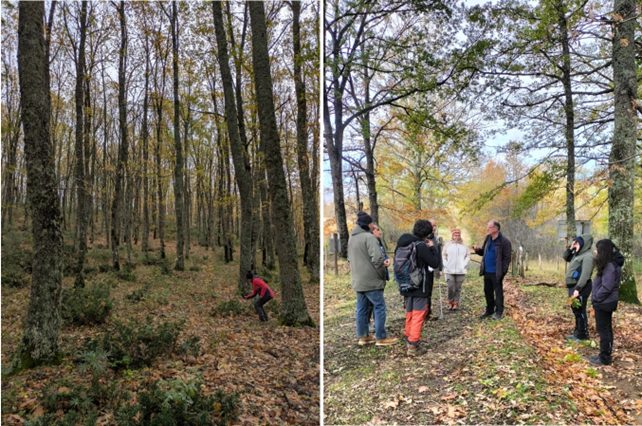
The second forest, owned by the Municipality of Castronuovo, is an even-aged, pure Italian oak stand with abundant oak regeneration. A uniform thinning was carried out years ago, fostering the abundant presence of regeneration. Surprisingly, no acorns were found on the soil, probably because of the occurrence of mast years. Some 300 m²-sized gaps derived from the removal of three adjacent trees had supported the growth of regeneration (probably pre-regeneration already present before the thinning), which is now surpassing two meters in height.
The stand was evaluated as suitable for installing a second device. The group discussed the silviculture to be pursued. Professor Bruciamacchie asked whether the aim of forest management was to promote a pure composition or to allow the scattered Turkey oak to regenerate in the stand. He criticized the Italian silviculture traditionally focused only on obtaining regeneration, Assuming that regeneration was not an issue (with the respected condition of the percentage of forest cover above 20% in a single-tree selection system), he emphasized the importance of promoting the quality of some promising mature trees. This was a perfect occasion to present the AFI approach to silviculture and quality wood promotion.
Professor Bruciamacchie noted that when many trees of good quality are present, tree selection becomes more difficult. He presented the optimal basal area to be maintained to pursue this silviculture in oak stands (between 15 and 18 m²) and outlined the relationships between basal area and annual volume increment to be considered when selecting trees to be cut.
The visit concluded with a satisfying round table at the restaurant, where a final technical meeting about installing the AFI monitoring devices was held. Professor Bruciamacchie stated that, for training the SMURF team, one device to be installed togheter could be sufficient. Since harvests need to be carried out two to three years after the installation, Bosco Magnano (Turkey oak stand) was evaluated as the most suitable option. Mauro Frattegiani from ProSilva Italy expressed the Association’s interest in studying Italian oak forests as well, an interest shared also by the other present researchers. Francesca Giannetti from UniFi reported that the installation of a second device in the Castronuovo stand (Italian oak) could have been evaluated.
The installation process and the parameters to be measured were presented in detail. Regarding the decay of single trees, Professor Bruciamacchie illustrated the ARCHI protocol (developed by CNPF) to dynamically monitor the resilience of the forest and individual trees to environmental stresses and competition dynamics. With the presented outcomes, the meeting concluded with the satisfaction of all participants. The skills gained in the AFI protocol and in irregular silviculture will be implemented across Europe to pursue Task 4.4 of the SMURF project, enabling forest owners and associations to adopt the CNS approach and reinforcing the project’s contribution to sustainable forest management